


Banks are investing in artificial intelligence (AI) with the hope that it will do more than answer questions. They want it to recommend products, negotiate prices and, increasingly, act on customers’ behalf. Yet the intelligence of an AI agent is only part of the equation. Its decisions are constrained by the quality of the information, commercial rules, and permissions available to it.
A bank may deploy an advanced model and still struggle to answer a deceptively simple question: what is the best offer this customer can legitimately receive? The answer may depend on eligibility, contractual terms, transaction volumes, tracking of commitments, relationship profitability, and pricing limits scattered across several systems.
The urgency is growing. KPMG’s 2026 Global AI in Finance research found that active AI use across the finance function has risen from 30% in 2024 to 75%. Yet the same research points to a critical constraint: 36% of organizations identify data quality as both a major barrier and an opportunity for expanding AI1. The figures suggest an industry moving beyond experimentation, but one whose ambitions may be running ahead of its foundations.
For banks, the next challenge is not simply to make AI smarter. It is to make the products on which AI operates intelligible, accessible, and governable. That requires a rethink of a familiar piece of banking infrastructure: the enterprise product catalog.
From Answering Questions to Making Decisions
AI-enabled banking is moving from information retrieval to recommendation and execution. Celent’s framework2 for customer-facing AI offers a useful way to understand the progression.
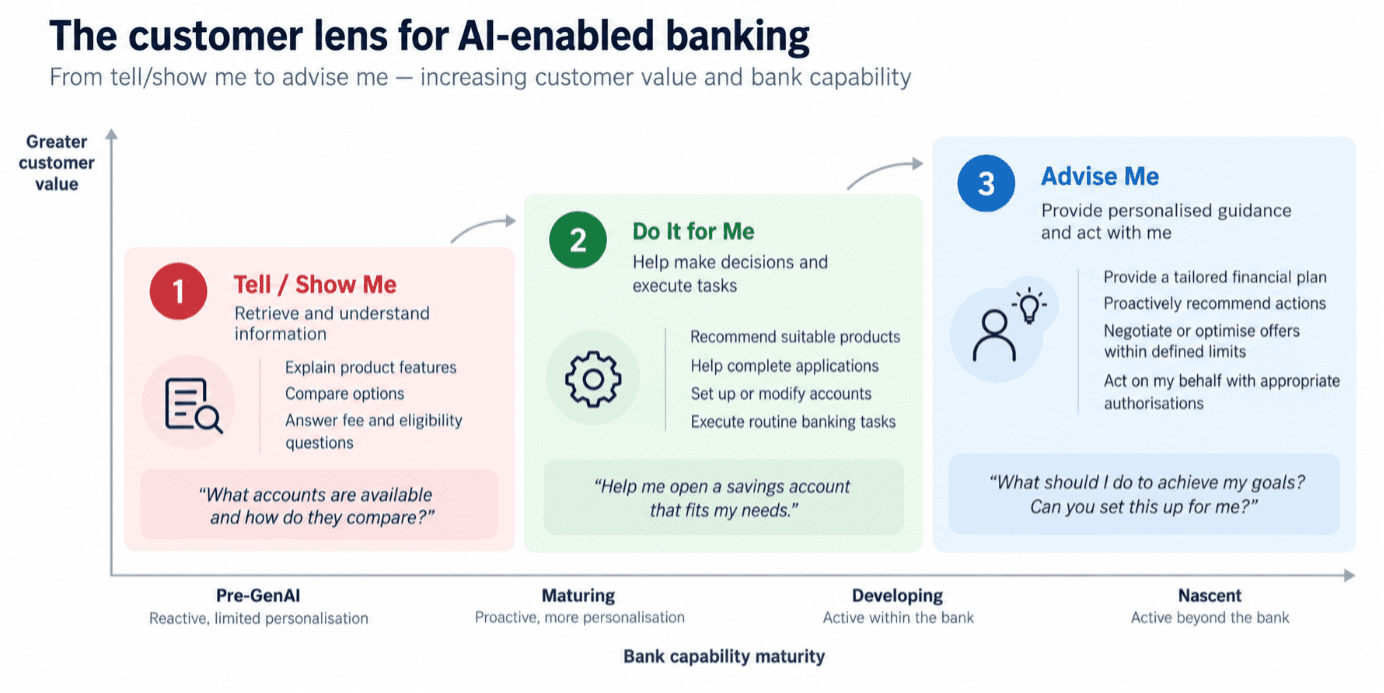
At the “Tell Me / Show Me” stage, an assistant retrieves product details, explains fees or compares deposit accounts. The task is relatively straightforward: find the relevant information and present it clearly.
At the “Do It for Me” stage, AI begins to initiate processes and carry out tasks. It may help configure a product, prepare an application or execute an action on a customer’s behalf.
The “Advise Me” stage is more demanding. Here, the agent must interpret a customer’s circumstances, assess alternatives, and recommend what should happen next. It may eventually negotiate terms or take action within defined limits.
Each step raises the stakes. An inaccurate product description can mislead a customer. An incorrect eligibility decision can result in an unsuitable offer. An unauthorized pricing concession can erode margins or breach contractual commitments.
The difficulty is not merely one of data retrieval. It is the difference between knowing what a product is and understanding the conditions under which it can be sold, priced, combined or changed. As AI moves from conversation to execution, the product environment must evolve accordingly.
The Intelligence Gap Inside the Product Catalog
Traditional product catalogs were designed primarily to define and manage products. They provide a structured record of product attributes, pricing, eligibility, benefits, and lifecycle information. They remain indispensable, but the demands of agentic banking go further.
In many banks, product definitions and commercial rules are distributed across product processors, pricing engines, channels, and operational applications. Different systems may hold different versions of the same information. Some rules may be encoded in software while others may depend on manual processes or institutional knowledge.
The consequences are not new. Banks have long struggled with inconsistent product definitions, slow launches, and fragmented customer propositions. AI makes these weaknesses more consequential because it can act on information at a speed and scale that magnify errors.
This is where the enterprise product catalog (EPC) can become more than a repository. It can form part of an intelligent product layer connecting what the bank offers with what its AI agents can understand and do.
Four Layers of an Intelligent Product Catalog
Such a transformation can be understood through four layers: Foundation, Orchestration, Governed Execution, and Intelligence. They represent progression from reliable information to controlled action and, finally, evidence-led improvement.
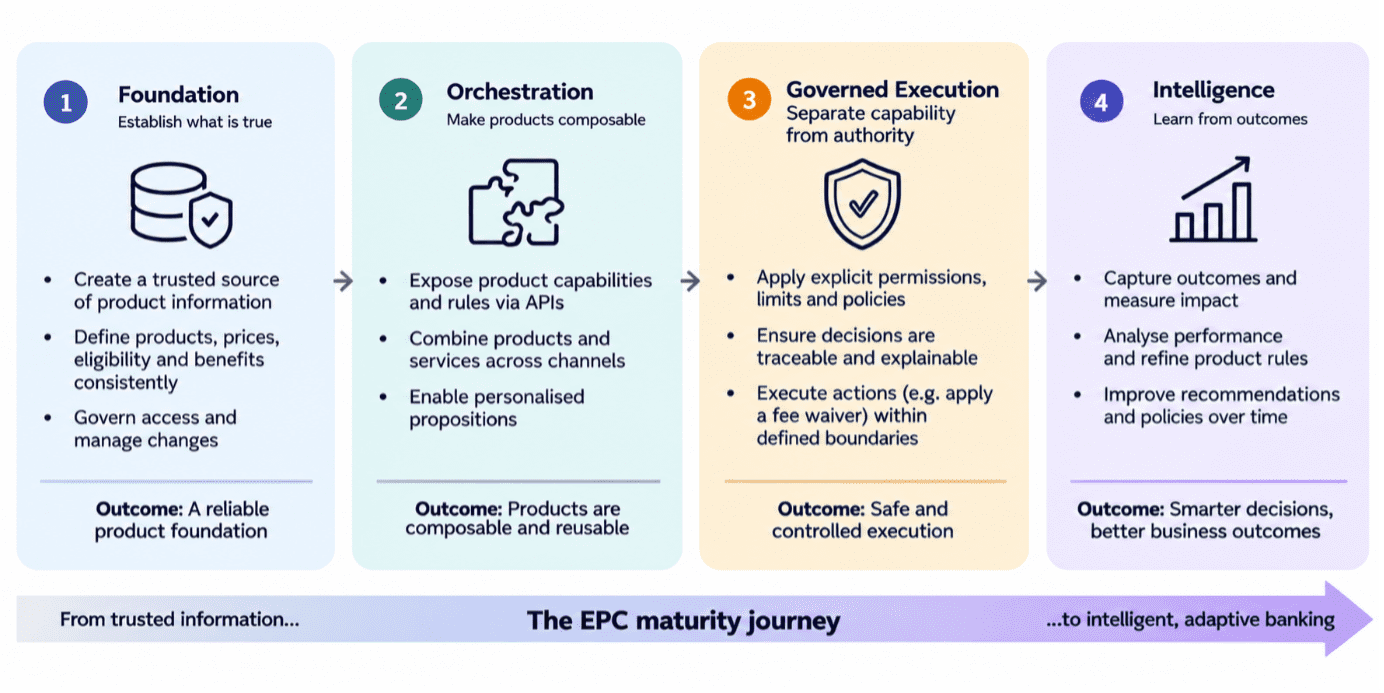
1. Foundation: Establish what is true
The first requirement is a trusted source of product information. Product definitions, prices, eligibility conditions, and benefits must be structured, versioned, and maintained consistently. Duplicate definitions must be identified; product changes must be traceable; and access must be governed according to the information and actions involved.
A reliable foundation allows an assistant to answer basic questions about available products and their features without drawing on conflicting versions of the truth. It also gives downstream applications a common reference point. The goal at this stage is not autonomy. It is trust.
2. Orchestration: Make products composable
A trusted catalog is necessary, but information alone does not enable an agent to act. Product capabilities and rules must also be accessible to the systems that need them.
APIs and standard interfaces can expose product attributes, eligibility logic, benefits, charges, and bundling conditions. Instead of remaining trapped in individual applications, these capabilities can be assembled and orchestrated across channels and services.
An agent could then evaluate which products a customer qualifies for, identify compatible combinations, and retrieve the conditions governing a proposed offer. A bank might use this capability to personalize bundles, configure products dynamically or recommend the next best product.
Yet composability must not be confused with authority. An API may make a pricing function available without establishing whether a particular agent should be allowed to invoke it. The ability to request an action is not permission to perform it. That is the next layer’s responsibility.
3. Governed Execution: Separate capability from authority
The commercial stakes rise when an agent can change a rate, waive a fee or negotiate a concession. Technical capability does not establish commercial authority.
A bank needs explicit rules governing who or what may take an action, for which customers, within which limits, and under what conditions. The system must also preserve enough evidence to explain the decision afterwards.
Return to the corporate fee negotiation example. The agent identifies a potential retention risk and recommends a concession. The product environment establishes whether the customer qualifies, which contractual and pricing conditions apply, and what limits govern the offer. A controlled execution service checks the agent’s authority before applying the change. The decision and its rationale are recorded.
This division of responsibility matters. The product catalog can supply the definitions and rules, while pricing engines, policy services, and transaction systems perform their respective functions. The AI agent reasons within that environment.
This creates the conditions for automated fee waivers, relationship-based pricing, and other commercial decisions to be performed within defined boundaries. It does not remove the need for human judgement. It makes the boundary between automated and human authority explicit.
4. Intelligence: Learn from outcomes without surrendering control
The final layer introduces a feedback loop. Information no longer flows only from the product environment to the agent; the results of decisions can also inform future policy.
Suppose the agent offers the corporate customer a fee reduction. The customer accepts. That outcome may help the bank understand how different offers perform across customer segments, relationship profiles, and product combinations.
But acceptance is not the same as success. The customer might have stayed without the discount. The concession may have been larger than necessary. A customer who rejects an offer may be responding to poor service rather than price. Without examining profitability, subsequent behavior, and the alternatives available, the bank may reward the wrong decisions.
An effective learning cycle therefore has several steps: record the outcome, assess its commercial significance, test whether the action caused the result, and determine whether the evidence justifies a policy change.
AI can help identify patterns and recommend adjustments. Controlled experiments can test their value. Accountable business owners can approve material changes to pricing and eligibility rules. And monitoring can detect deteriorating outcomes, while audit trails preserve the basis for decisions.
Outcomes That Get Unlocked
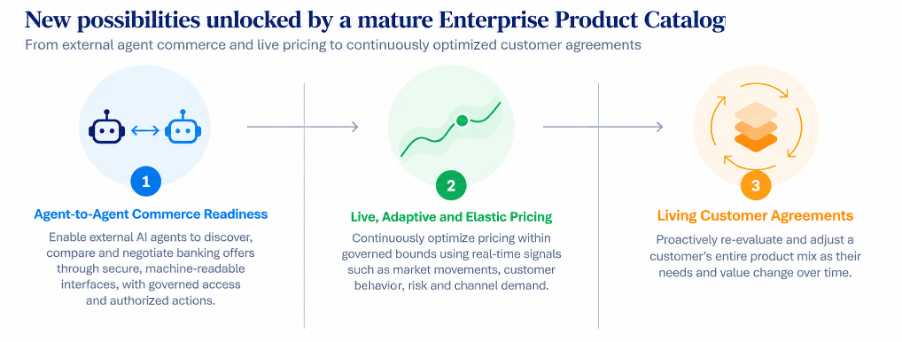
Agent-to-Agent Commerce Readiness
As businesses increasingly use AI agents to evaluate banking services and negotiate commercial terms, banks need to make product capabilities, eligibility, and pricing accessible through secure, machine-readable interfaces. A mature enterprise product catalog provides trusted product definitions and commercial rules that enable external agents to discover relevant offers and initiate authorized actions, supported by banking APIs and governance controls.
Live, Adaptive, and Elastic Pricing
Traditional rate cards are reviewed periodically (quarterly or annually). A mature revenue management layer instead maintains reinforcement-learning-tuned price curves that adjust continuously within governed bands, informed by real-time signals — market movements, customer behavior, risk, and channel demand — rather than static tiers revisited on a fixed cycle.
Living Customer Agreements — Continuous Relationship-Level Optimization
Cross-sell and bundling today are largely point-in-time events (at onboarding or a sales conversation). With a composable, continuously orchestrated catalog, an agent can re-evaluate a customer’s entire product mix on an ongoing basis as circumstances change — a change in transaction volume, a new life event, a shift in relationship profitability, and then propose adjustments proactively rather than waiting for the next interaction.
Smarter Agents Need Smarter Products
The next phase of banking AI will be a test not only of models, but of the institutions deploying them. Banks that give agents access to consistent product definitions, executable rules, and clear limits will be better placed to turn intelligence into commercial action. Those that do not may find that their most sophisticated models are reasoning over conflicting eligibility rules, outdated prices, and permissions nobody has properly defined.
The competitive advantage will not come from AI capability alone. It will come from combining intelligence with the means to act on it: products that can be understood, composed, priced, and governed consistently, and whose outcomes can be assessed and improved.