Every business has a legitimate reason for operating the way it does. But the customer’s experience can become fragmented.
One invoice comes from one LoB. Another arrives from a different one. Charges may follow different billing cycles. Fee descriptions may vary. Credits and adjustments may appear separately. Some charges are detailed at transaction level; others are aggregated.
The customer now must bring all of this together to understand the cost of their relationship with the bank.
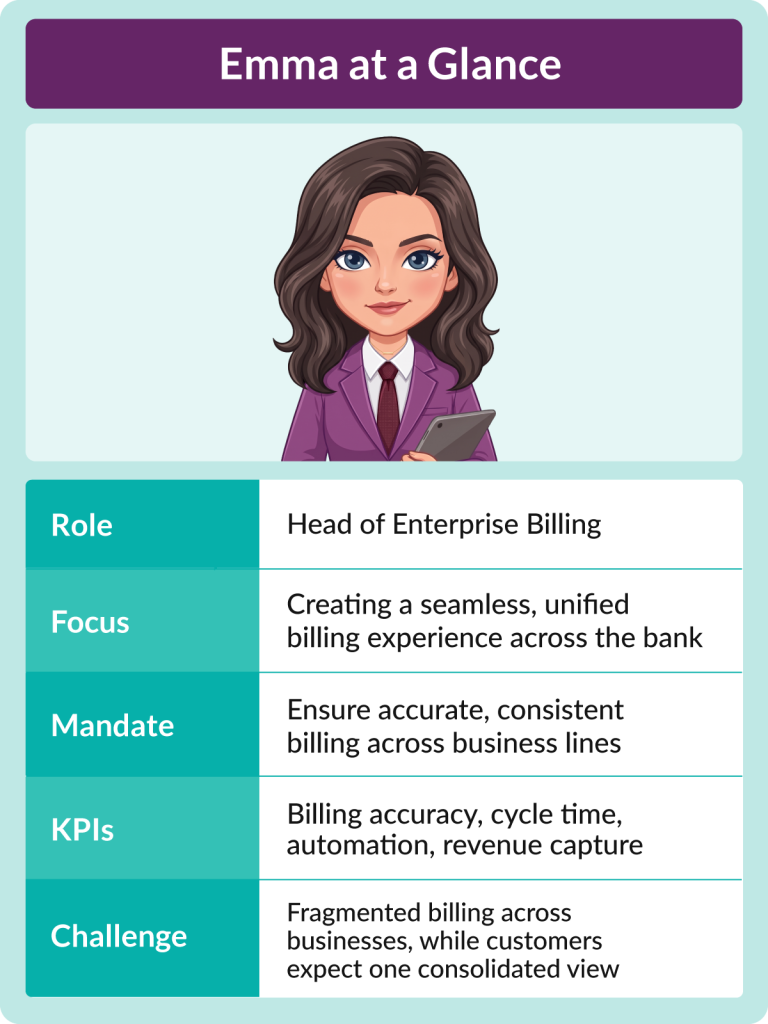
The bank sees multiple billing streams. The customer sees one relationship. That’s the gap Emma is trying to close.
The Problem Isn't the Number of Products
Emma doesn’t believe the answer is to make every business operate in the same way. A trade finance product has different commercial logic from a custody service. Payment may be charged per transaction, while another service may use a recurring fee or relationship-based pricing. The underlying complexity is legitimate.
The problem is what happens when that complexity reaches the billing experience. Different businesses may use different billing systems. Fee calculations can happen in different places. Customer-specific terms may be maintained separately. Data required to calculate a charge may sit outside the system generating the invoice.
The result is a billing landscape that mirrors the bank’s internal structure. And customers end up navigating it.
EY cites research showing that 60% of companies do not periodically reconcile bank charges against agreed rates, while 80% struggle with visibility into global banking operations1.
When Fragmentation Becomes a Customer Problem
For Emma, the warning signs are familiar. A corporate customer questions why a negotiated discount hasn’t appeared on one invoice. Another asks why charges for related services are appearing separately.
A relationship manager needs to explain why the amount billed doesn’t match what the customer expected. A billing discrepancy can quickly become a dispute, triggering investigations across billing, operations, finance, and the relationship team. Operations teams investigate individual charges across different systems. Finance teams reconcile billing outputs before they can get a complete view of revenue. None of these issues necessarily indicate that a billing system is fundamentally broken.
The problem is that the pieces don’t always connect. And when they don’t, relatively simple customer questions can require surprisingly complex internal investigations.
What should be a straightforward question, “How much did we charge this customer?”
And did everything actually make it onto the bill?
The Cost of Billing in Fragments
The impact goes beyond customer frustration.
Fragmented billing creates work across the bank. Billing teams spend time reconciling information from different systems. Operations teams investigate exceptions. Relationship managers become intermediaries between customers and billing teams, with cross-product discounts becoming particularly difficult to implement and explain. And finance teams work to establish a complete picture of revenue.
Customers, meanwhile, may have their own reconciliation burden. They must consolidate invoices from the same bank before they can understand their total banking costs. And the more complex the relationship becomes, the harder that gets.
A global corporate customer with multiple entities, products, and markets may not just receive more invoices. It may receive a different version of the relationship on every invoice. That’s when billing stops being simply a transaction-processing function. It has become a customer-experience issue.
Emma's Real Challenge: Connecting the Pieces
The challenge is no longer simply getting billing data electronically. A 2025 Redbridge survey of global and regional banks found that the focus is shifting toward the quality, consistency, and usability of bank billing data2, including inconsistencies between contracted pricing and monthly billing data.
Emma’s team has already automated much of the billing process. But automation alone doesn’t solve fragmentation. You can automate ten separate billing processes and still end up with ten separate billing experiences.
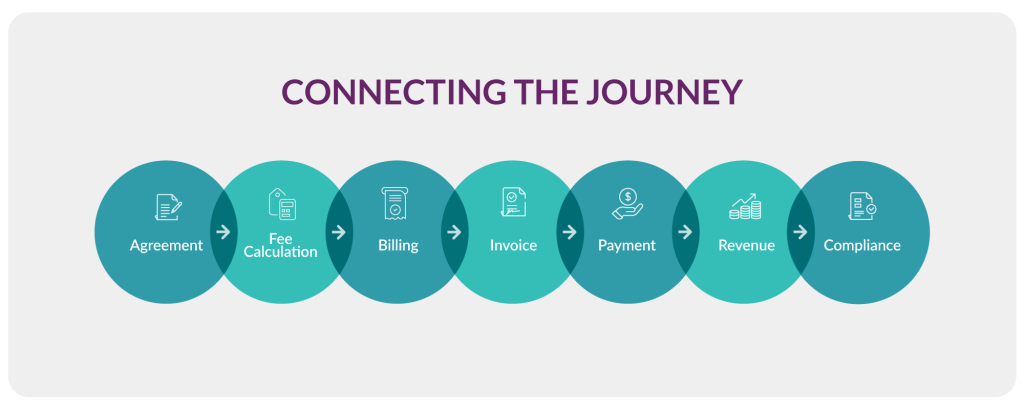
What Emma needs is a way to connect them. She wants the bank to retain the specialized billing logic required by each business, while giving customers a much more coherent view of their relationship.
That means connecting the journey across:
And doing it across business lines, products, entities, and markets.
The goal isn’t to erase the differences between businesses. It’s to make those differences invisible where they don’t need to matter to the customer.
From Fragmented Billing to a Consolidated View
Imagine that same corporate customer opening its billing statement. Instead of navigating a collection of disconnected invoices, it sees a consolidated view of its relationship with the bank. Charges from different businesses are brought together.
The customer can understand what it pays for across services, entities, and markets. The underlying fee calculations still reflect the commercial arrangements of each business. But the customer no longer must reconstruct the relationship themselves.
For Emma, that’s the distinction between billing automation and billing unification.
Automation makes individual processes faster. Unification makes the overall billing experience coherent.
Where the Intelligent Revenue Layer Comes in
This is where an Intelligent Revenue Layer changes the role billing can play.
Rather than treating pricing, fee calculation, billing, collections, and revenue visibility as disconnected processes owned by different parts of the bank, it provides a connected layer across them.
For Emma, that means the bank can preserve the flexibility of its individual businesses, while creating a more unified commercial experience for the customer.
A customer can have different products. Different pricing models. Different contractual terms. Different billing requirements. But still have one connected view of what those relationships mean commercially.
So, when a customer asks, “What are we paying you?”, the bank has a connected answer. Not ten answers from ten businesses. All while ensuring clients can still receive bills in their preferred format without losing the holistic view.
The Bank Can Stay Complex. The Billing Experience Shouldn't Have to.
Emma knows the bank isn’t going to stop becoming more complex. New products will be added. Customers will negotiate bespoke arrangements. Businesses will continue to operate with specialized processes. Global relationships will continue to span entities, markets, and currencies. That’s the reality of modern banking.
The opportunity is to stop that complexity from spilling over into the customer experience. And Emma believes the billing experience should reflect that. One customer. One relationship. One connected view of the charges behind it.
An intelligent billing system brings every charge into one connected view, while allowing customers to choose their preferred billing format, without losing the 360-degree view of the relationship.